


Yes. In-app bidding removes much of the manual ranking work that dominated waterfall operations. It does not remove ad operations.
When eligible demand sources bid simultaneously, the mediation platform chooses a winner for each impression. Google describes bidding as a real-time auction in which participating sources compete for every impression. Its AdMob bidding overview explains the core mechanism.
An AI AdOps agent should not try to outguess that auction impression by impression. Its job moves up a level. It decides which traffic enters which auction, which partners participate, what constraints apply, how experiments are structured and whether the result improves the publisher’s business.
What bidding automates
Traditional waterfalls rank network instances using historical eCPM estimates. Teams create lines, set prices, monitor fill and move those lines when performance changes.
Bidding changes the sequence:
| Waterfall | In-app bidding |
|---|---|
| Sources are called in a preset order | Eligible sources respond in parallel |
| Historical eCPM helps set rank | Current bid helps decide the winner |
| Manual line maintenance is common | Auction handles much of the ranking work |
| Latency can grow as the chain continues | Parallel calls can reduce serial waiting |
| The operator manages many price points | The operator manages participation and rules |
This is a real reduction in manual work. It is not a complete decision system.

What the auction cannot decide
The auction sees the impression it is asked to price. It does not own the publisher’s broader objective.
It cannot independently decide:
- Whether an ad should be shown at that moment.
- Whether one cohort should see fewer interstitials.
- Whether a placement harms session depth.
- Whether a country needs a separate configuration.
- Whether revenue gains are incremental.
- Whether a partner’s latency or creative quality is acceptable.
- Whether a floor should differ by format or audience.
- Whether a configuration should be rolled back after a retention decline.
These decisions require data outside the auction, including player events, session behavior, purchases, retention and experiment assignment.
The new control surface
In a bidding-heavy stack, AI AdOps has five useful areas of control.
1. Traffic segmentation
One auction setup rarely fits every country, platform, format and placement. An agent can identify segments with different demand density or user sensitivity and recommend a separate configuration.
Segmentation must remain economical. Every split reduces the observations available to the model. Our guide to traffic requirements for AI monetization explains why total DAU is a poor readiness test.
2. Partner participation
A bidder that rarely responds, adds latency or serves poor creatives may reduce total value despite occasional high bids. The agent can monitor bid rate, win rate, show rate, revenue, latency and quality signals together.
This is different from removing a network after one weak day. Participation changes need adequate evidence and an easy reversal path.
3. Floors and hybrid lines
Many mediation stacks remain hybrid. Bidding sources compete alongside waterfall or non-bidding demand. Google documents mediation groups that combine bidding and waterfall sources, and its Ad Inspector shows how a bidding winner can enter the waterfall according to eCPM. Google’s mediation setup guide covers both integration types.
An agent can test floors or remaining waterfall values where the platform exposes them. A floor still has a trade-off: higher price per filled impression can reduce match and total revenue. See what happens when an agent makes a bad floor decision.
4. Placement and frequency rules
Auction efficiency does not protect the user experience. An agent can help test interstitial cadence, rewarded prompts or app-open eligibility while watching engagement and retention.
These controls usually live in the app, remote configuration or a monetization platform rather than inside the bidder.
5. Experiment allocation
An agent can maintain a control group, assign bounded test traffic and compare total value. This is often the largest remaining opportunity because auction reports show what happened, while a controlled experiment estimates what changed because of the intervention.
Data the agent needs
Impression-level revenue is the best starting point. Google’s SDK can provide value, currency, precision type, ad source, instance and mediation experiment fields when an impression occurs. Google’s ILR guide documents the callback and advises sending the event to an analytics server immediately.
The minimum event model should connect these fields:
| Data group | Useful fields |
|---|---|
| Auction result | Network, instance, bid or revenue value, format |
| Placement | Ad unit, placement, screen, trigger |
| User context | Country, OS, app version, consent state |
| Experience | Session, level, time since last ad, ad frequency |
| Business outcome | Retention, IAP, session length, churn proxy |
| Experiment | Control or treatment, configuration version |
Aggregated dashboard totals are too coarse for many decisions. They can identify a problem. They rarely explain which cohort, placement or release caused it.
A safe operating loop
AI AdOps around bidding should follow a strict sequence:
- Detect a stable opportunity using recent and historical data.
- Check data freshness, consent rules and minimum sample size.
- Propose one bounded change.
- Assign a persistent control group.
- Launch to a small share of eligible traffic.
- Monitor revenue, fill, latency, retention and purchases.
- Expand, hold or roll back according to preset rules.
- Record the decision and outcome.
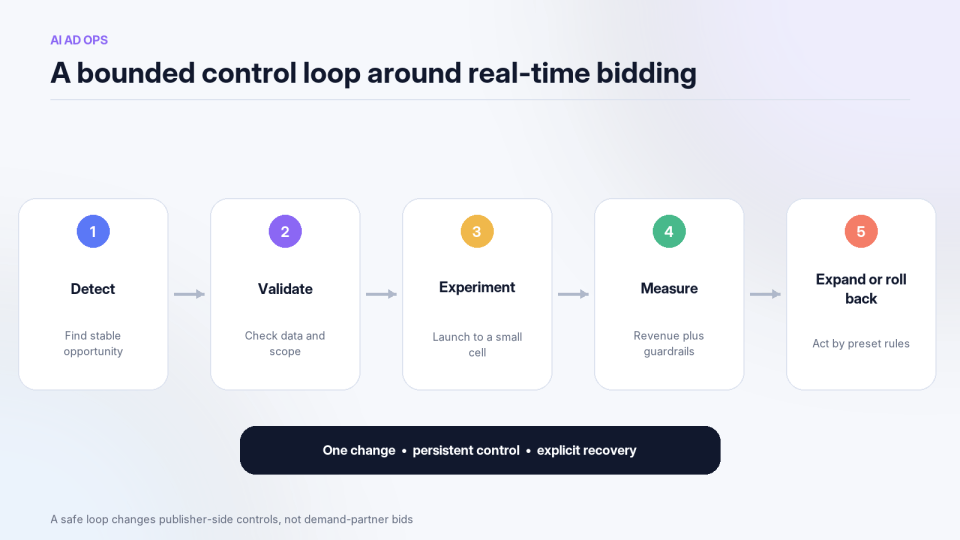
The agent should never silently widen scope. A test approved for Android rewarded inventory in Canada should not drift into iOS interstitial traffic because early revenue looks good.
Metrics that matter in a bidding stack
eCPM alone is weak. A higher eCPM may come with fewer impressions or a worse show rate.
Use a scorecard:
| Metric | Question answered |
|---|---|
| Bid rate | Is the source participating? |
| Win rate | Is it competitive? |
| Match rate | Does the auction return an ad? |
| Show rate | Do matched ads reach the screen? |
| Revenue per request | What is each opportunity worth? |
| Revenue per active user | Does the full session earn more? |
| Latency | Is monetization slowing the experience? |
| Retention and session depth | Is the change costing future value? |
The desired outcome is more incremental value per user within experience limits.
When AI AdOps adds little value
Automation may be premature when the app has one placement, little traffic, unstable instrumentation or a single demand source. The agent would have few useful choices and weak evidence.
Fix the basics first:
- Verify adapters and SDK initialization.
- Capture impression revenue reliably.
- Use consistent placement names.
- Correct show-rate and latency problems.
- Establish a control group.
- Define who can approve changes.
Google’s mediation documentation warns that initialization must finish before loading ads so all networks can participate. No model can repair missing bids created by a broken integration.
The answer
Bidding handles price competition for an eligible impression. AI AdOps handles the operating decisions around those impressions.
That leaves plenty of work: segmentation, participation, floors, placement rules, experiments, monitoring and rollback. The value comes from connecting auction data to product outcomes and making bounded changes faster than a manual team can.
Frequently asked questions
Does in-app bidding eliminate waterfalls?
Some stacks are heavily bidding-based. Many still combine bidding sources with waterfall demand or direct lines. The exact mix depends on the mediator and integrated networks.
Can an AI agent change bids from ad networks?
Usually no. Demand partners decide their bids. The agent can manage publisher-side configuration and traffic rules where the mediation platform exposes them.
What is the best metric for bidding optimization?
No single metric is enough. Revenue per request or active user should be evaluated with match rate, show rate, latency, retention and purchase behavior.
Does UndrAds replace the mediation auction?
No. The mediator runs ad delivery and the auction. UndrAds works on operating decisions around that infrastructure.


