


AI in ad operations can help publishers detect changes, evaluate responses and carry out approved actions. Its value depends on the data it receives, the decisions it is allowed to make and the evidence that those decisions improve the business.
Start with the work your team needs done. A reporting assistant, an anomaly detector and a system permitted to change floors have different responsibilities. Ask what each component observes, what it changes, how it records the reason and how the team can stop or reverse an action.
What automation already does
Automation can be useful without requiring a learning model. A scheduled report or a deterministic rule may be exactly right for a stable task. Common examples include:
- Applying approved bid or floor adjustments within defined limits.
- Scheduling and distributing operational reports.
- Flagging anomalies for investigation.
- Checking advertising creatives against defined review criteria.
Distinguish a fixed rule, a statistical model and an AI assistant in the evaluation. A vendor should be able to explain which mechanism supports a feature. The business question is whether the feature produces a reliable outcome at an acceptable cost.
A model that predicts a useful signal can still fail operationally if data arrives late or the execution path is unavailable. Conversely, a simple rule can prevent an expensive configuration mistake. Evaluate the entire workflow instead of treating the label “AI” as evidence of superior performance.
Measure your monitoring and response gap
There is no universal four-hour dashboard-check interval or predictable revenue-decay cycle shared by all publishers. Measure the timeline in your own incidents:
- Identify when the underlying change began, separating event time from report availability.
- Record when the team or system detected and diagnosed the issue.
- Record when an approved response reached production and whether it helped.
Use these four stages to build an incident record. Actual timestamps and comparable cohorts are more useful than an unsupported industry-wide loss estimate.
| Stage | Record | Question |
|---|---|---|
| Change begins | Event time and affected inventory | Was this demand, traffic mix, delivery or reporting? |
| Signal becomes available | Data arrival time and completeness | Could any system have detected it yet? |
| Diagnosis and response | Decision, approver and deployment time | Was the action appropriate and permitted? |
| Outcome review | Revenue, volume and user effects | Did the response improve the combined result? |
Missing observations should remain missing. If a report refreshes hourly, claiming second-by-second detection requires another genuinely timely source. Keep data latency visible in service expectations.
The three layers of AI in ad operations
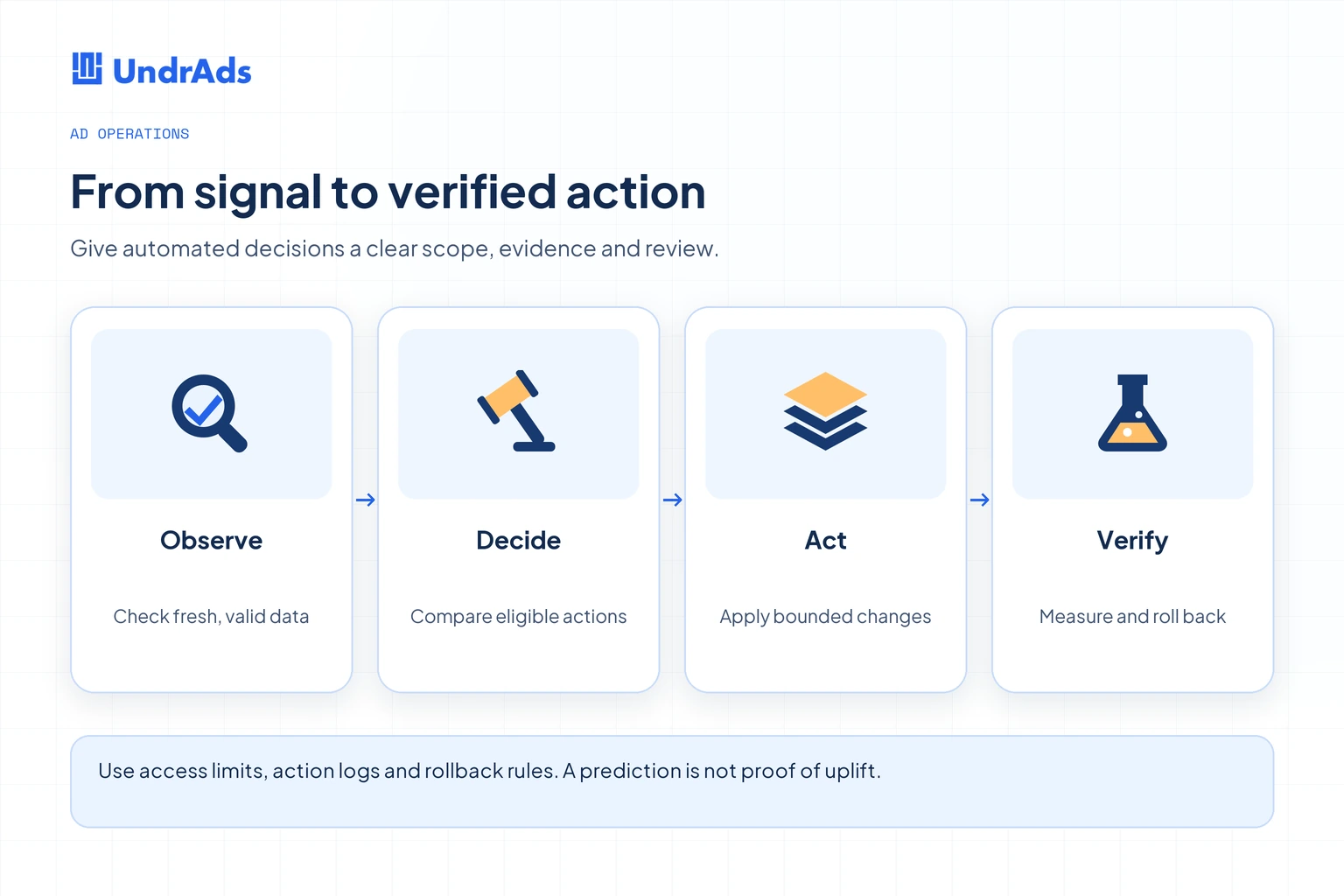
Layer 1: Signals and measurement
The observation layer identifies what changed and whether the data is trustworthy. Useful signals can include:
- Bid participation or density, where the platform exposes it.
- eCPM differences within comparable country and format cohorts.
- Load latency, timeout and show-failure patterns.
- Ad availability relative to eligible requests.
- Match and show rates under the platform’s definitions.
- Request volume by app version, placement and audience.
Check freshness, missing values and changes in definitions before interpreting the signal. An app release that renames placements can resemble a revenue collapse in the old placement. A delayed partner export can look like lost demand until the data catches up.
Segment selectively. Country, platform and format are useful when they explain a plausible cause. Creating hundreds of tiny segments and escalating every fluctuation can overwhelm operators with noise. Set alert thresholds and sample requirements appropriate to the decision.
Layer 2: Decisions and constraints
The decision layer turns a signal into a candidate action. It should compare the expected benefit with implementation risk, available evidence and limits set by the publisher. A prediction alone does not establish that the proposed change will produce incremental revenue.
| Approach | Useful role | Limit |
|---|---|---|
| Reactive analysis | Investigate an observed change and propose a response | Can misdiagnose delayed or incomplete data |
| Predictive analysis | Estimate a future outcome or compare candidate settings | Depends on assumptions and can be wrong under changing conditions |
For example, a higher floor may improve the average price of remaining impressions while reducing total earnings. Google’s floor documentation explains the eligibility trade-off. A decision system needs the total business objective, rather than a single rate to maximize.
Ask for the data window, relevant cohort, proposed change and reason. Useful explanations connect evidence with an action the team can inspect. A fluent paragraph generated after the fact is insufficient if it cannot be tied to the actual decision record.
Layer 3: Execution and verification
Execution makes an approved change through an available integration. Verification then checks whether the intended configuration reached production and whether the outcome was acceptable. Three operating conditions matter:
- Global audiences may require monitoring outside the local team’s working hours.
- Platform APIs, permissions and reporting delays limit what can be changed and observed.
- Some changes are reversible in a console, while SDK or placement changes may require a release.
Set access limits, action bounds, change logs and rollback rules before enabling autonomous execution. Prevent two systems from changing the same setting independently. Otherwise, neither the model nor the operator may know which configuration produced the result.
Maintain an escalation path for policy notices, crashes, missing rewards and unusual traffic. The system should pause or hand off when evidence is insufficient or an action would exceed its authority. Speed helps only when the response is appropriate.
What the industry research actually establishes
The IAB State of Data 2026 report discusses AI-powered measurement and challenges involving governance, accuracy, security and data quality. Those survey findings describe the respondents and measurement context. They do not establish a universal publisher reaction delay or guaranteed monetization uplift.
Use three evidence checks when reviewing a revenue claim:
- Population: identify which publishers, inventory and reporting periods the evidence covers.
- Comparison: establish the baseline, control or other method used to estimate incremental value.
- Outcome: check total revenue, costs and user effects rather than selecting one favorable rate.
Keep historical survey years intact. Vendor case studies can provide useful questions for a pilot, but their outcomes should not be copied into your forecast without a comparable basis.
A six-part strategy checklist
- Map coverage. Identify the signal, decision and execution components already operating in your stack.
- Measure response time. Use actual incident timestamps and show data latency separately from operator delay.
- Require traceability. Save the evidence, action, scope and configuration version behind significant changes.
- Define the business objective. Include revenue per user, retention, reliability and operating cost where relevant.
- Improve the data foundation. Reconcile definitions, missing data, time zones and access before expanding automation.
- Introduce bounded autonomy. Start with reviewable actions, then expand authority only after useful results and safe recovery are demonstrated.
Assign an owner for each part. A tool can produce excellent recommendations that nobody acts on, or execute changes that nobody reviews. Ownership connects the workflow with a maintained business process.
Test the control loop before expanding authority
Use a limited pilot to inspect one decision type from input to outcome. Choose a setting with an understood scope and a practical rollback path. Keep the existing configuration and identify which other tools or people can modify it during the test.
Replay a few historical incidents where suitable data is available. Check whether the system would have received the information in time, whether its suggested action was actually supported and whether the explanation matched the evidence. A retrospective model should not be credited with information that arrived after the original decision window.
Then evaluate a controlled live rollout. Confirm that commands reached the intended inventory, limits were respected and logs identify the configuration in effect. Separate a failed API call from a successful action that produced an unfavorable business result. They require different fixes.
Review operating effort as well as revenue. An alert stream that requires constant correction can add work, while a well-scoped automated action can reduce routine handling. Keep the evaluation specific enough that the team can decide whether to retain, revise or stop the workflow.
Make the pilot record reusable. Preserve the definitions, configuration limits and acceptance tests alongside the result. When the system is expanded to another app or market, review which assumptions still apply. A successful test in one placement is useful evidence, but it does not establish identical behavior across every supported integration or audience.
Where UndrAds fits
UndrAds offers automated monetization operations for supported publisher stacks. Evaluate the proposed integration and operating agreement against these five requirements.
| Requirement | What to confirm |
|---|---|
| Monitoring | Available metrics, update frequency and data quality checks |
| Diagnosis | Evidence behind an anomaly and proposed response |
| Action scope | Permitted settings, limits, approval and rollback |
| Integration | Exact requirements for the existing platform and app |
| Communication | Supported alerts, action logs and human escalation |
Integration varies by stack. UndrAds describes a MAX route without an additional SDK and an AdMob adapter path. Confirm your actual requirements instead of promising every publisher a development-free implementation.
Run a measured pilot with comparable traffic and a clear baseline. Keep commercial terms, access and change ownership explicit. The result should show whether the service improved the overall outcome and reduced useful operating work, with enough evidence for the publisher to assess both.