
In-app bidding and waterfall mediation are mechanisms for coordinating supported advertising demand. For 2027, choose between them using integration requirements and a measured business result. There is no universal DAU cutoff or guaranteed revenue uplift that settles the decision.
This guide retains four stages for each mechanism, six evaluation criteria, four waterfall advantages and limitations, five bidding advantages, four bidding limitations, four hybrid considerations and a five-step decision process.
What is the Waterfall Model?
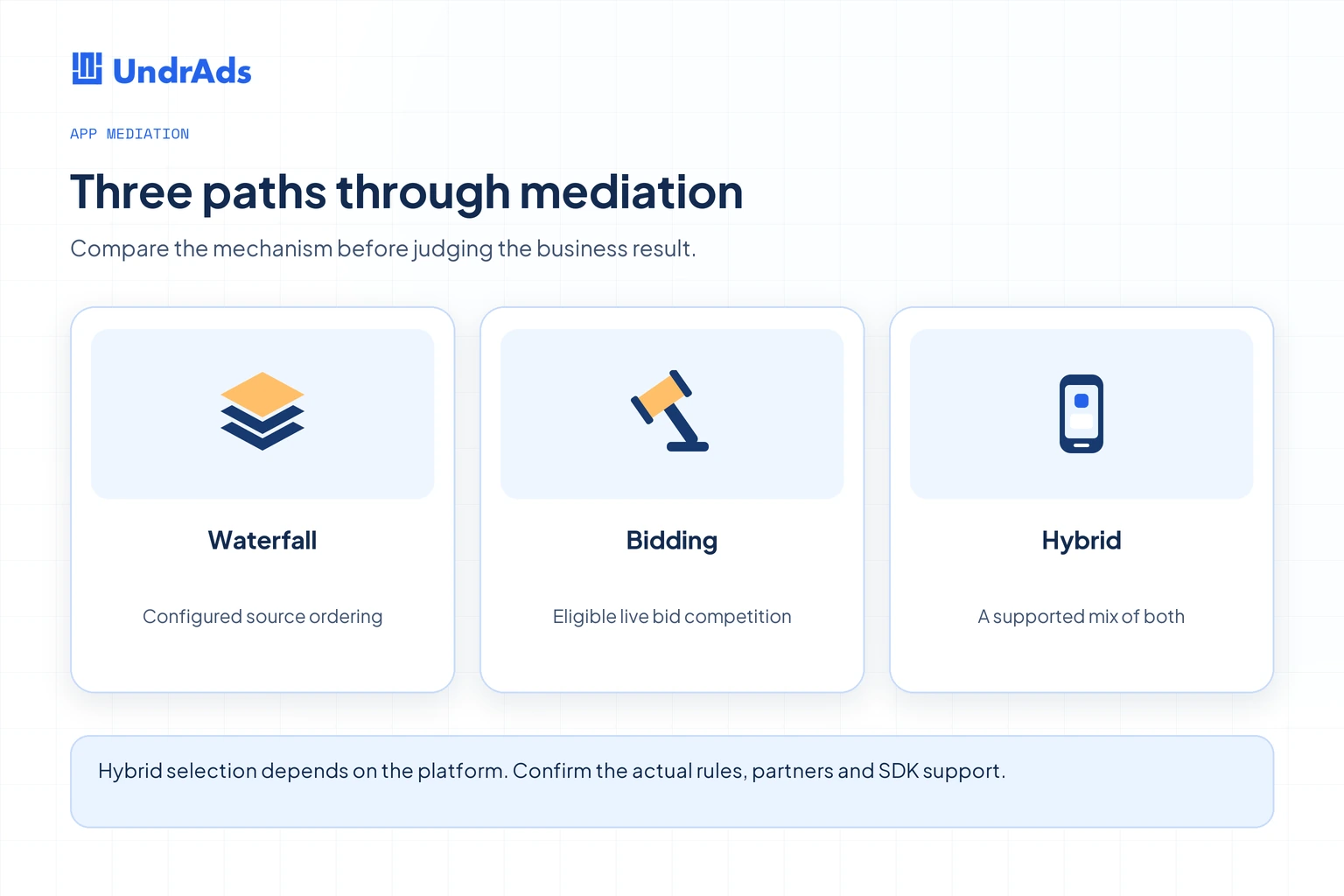
Waterfall mediation calls eligible advertising sources according to configured ordering and values. Those values can reflect historical estimates rather than live bids for the current opportunity. It remains a supported mechanism in relevant platforms, but its usefulness depends on actual partners, configuration and measured results.
How It Works
The four stages below explain a simplified waterfall path. Exact rules differ by platform, source and format. A request is not yet an impression, and a returned response is not necessarily displayed. Keep those events separate throughout implementation and reporting.
Step 1: Ad Request Is Triggered
The app creates an eligible ad opportunity under its product rules and privacy flow. The mediation integration uses the relevant configuration to determine which sources can be called. Correct identifiers, mappings and compatible dependencies are prerequisites for a meaningful commercial comparison.
- The selected app, format and ad unit
- The eligible source configuration and ordering
- The platform’s applicable floor and targeting rules
Step 2: Call the first eligible source
The first eligible configured source is called. It does not automatically receive a billable impression merely because it was first in the sequence. The source must return a usable ad and the app must reach a valid display opportunity under the supported implementation.
- The source returns a usable eligible ad
- The source does not return an eligible ad within the supported process
Step 3: Request Moves Down Sequentially
If the first call does not produce a suitable response, the integration follows its supported progression rules. Timeouts and unavailable demand can affect the eventual result. Do not interpret every unfilled request as evidence that a different source would definitely have served profitably.
- A suitable source returns an ad that can be displayed
- The eligible sequence ends without a usable ad
Step 4: Performance Tracking and Manual Optimization
Review the source values and observed delivery under the actual traffic conditions. Some platforms support automated optimization for selected sources, so waterfall should not be described as necessarily entirely manual. The publisher still owns configuration, integrations and the interpretation of the result.
- Revenue and recorded impressions
- Availability and actual display behavior
- Country and platform differences
- Changes in traffic and app versions
- Review configured source values or floors
- Adjust eligible source ordering where supported
- Add, remove or repair a partner integration
Example Scenario
Consider three illustrative ordering values. They are not promises that a source will pay those amounts for the current impression. If Source A is called first, it may return an eligible ad before a later source is considered. That explains the mechanism, not the value of an unobserved alternative response.
- Source A: illustrative ordering value of $15
- Source B: illustrative ordering value of $12
- Source C: illustrative ordering value of $9
When a waterfall configuration can fit
A waterfall configuration can remain useful when it meets a real integration or business requirement. Small traffic alone does not make it the correct default, and a large audience alone does not make it wrong. Review partner support, operating work and the full placement result.
- A required partner uses a supported waterfall path
- The configured routing fits an actual commercial requirement
- The team can maintain its source values and mappings
- A measured comparison supports keeping the arrangement
What is In-App Bidding?
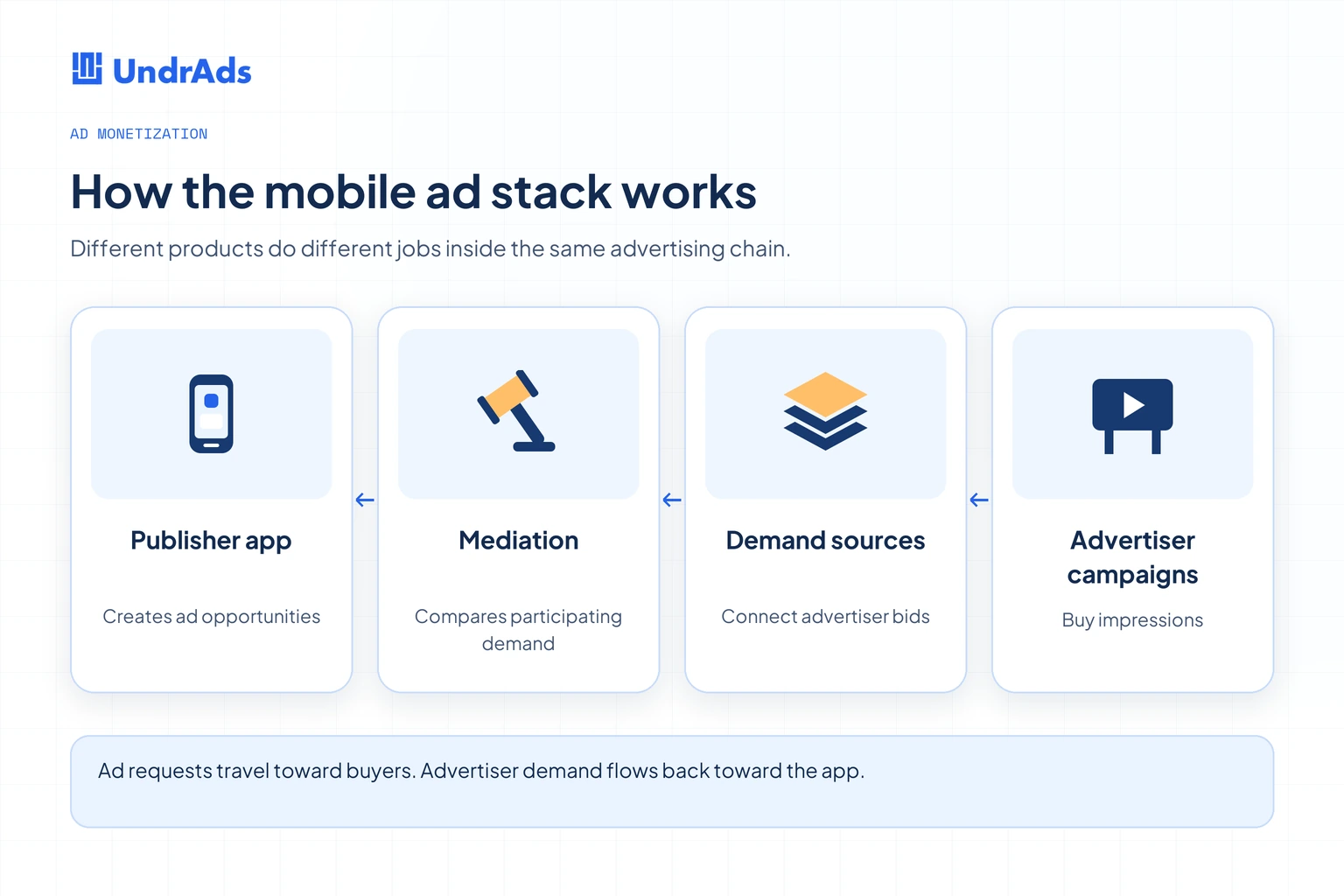
In-app bidding allows supported demand sources to submit eligible live bids for an advertising opportunity through the selected mediation arrangement. It coordinates participating demand; it does not expose every possible advertiser globally or guarantee that every request receives a valid bid.
How It Works
The four stages below describe the bidding path at a high level. Read the selected mediator’s current guide for actual eligibility, ordering and source behavior. Google’s mediation documentation distinguishes bidding and waterfall and permits a supported mix of both.
Step 1: Ad Request Is Triggered
The app must still establish a suitable placement and request. Bidding does not replace product eligibility, consent handling, initialization or format-specific implementation. A late response can be inappropriate to display if the user has already left the intended context.
Step 2: Unified Auction Begins
Supported sources receive the opportunity under applicable rules and decide whether to respond. Available signals, eligibility and integration conditions affect participation. Do not describe the auction as a guarantee that every installed network SDK competes on every request.
- The request is eligible to participate
- The relevant platform and format are supported
- The required privacy and audience signals are handled
- The bidder has valid account and placement mapping
- The response meets applicable auction and delivery conditions
Step 3: Select an eligible response
The platform selects an eligible response under its documented rules. “Highest bid” refers to the participating eligible competition in that process, not proof that the app captured the highest possible value from all potential buyers. Delivery and display must still succeed.
- An eligible bid is selected under the platform’s rules
- The integration obtains and displays a valid ad
- The corresponding events and revenue are reported
Step 4: Report and maintain the configuration
Live competition can reduce some manual source-ranking work, but account configuration, SDK updates, quality review and reporting remain. Check which fields are actually exposed. A bidding feature does not automatically provide complete bid-level transparency or remove the need for reconciliation.
- Eligible bid participation where exposed
- Recorded wins and displayed impressions
- Revenue on a consistent reporting basis
- Loading and show performance
- App stability and user outcomes
Example Scenario
Suppose four eligible bids in a simplified illustration are $7.20, $6.95, $6.80 and $5.90 CPM. Under a straightforward highest-eligible-bid comparison, $7.20 is the selected value. This example explains arithmetic and selection; it is not a benchmark or a promised publisher payment after every possible adjustment.
- Bid A: illustrative $7.20 CPM
- Bid B: illustrative $6.95 CPM
- Bid C: illustrative $6.80 CPM
- Bid D: illustrative $5.90 CPM
Why publishers evaluate bidding
Publishers may evaluate bidding to improve competition or reduce particular configuration tasks. Those are hypotheses to measure. Review the required release, partner approvals and reporting changes before assuming the migration is either effortless or automatically beneficial.
- A supported live competition mechanism
- Less manual ordering for participating bidders
- Access to relevant eligible partners
- A maintainable measurement and integration path
Evaluation Criteria Buyers Actually Use
Use six evaluation criteria across the same app, placement, audience and reporting basis. The commercial mechanism is only part of the decision. Include engineering, product and operations in the review so that a favorable rate does not conceal a broken experience or excessive maintenance.
1. Incremental business value
Start with total revenue per eligible user and the product outcomes relevant to the placement. A higher winning eCPM with fewer displayed impressions may produce less revenue. Keep purchases, retention and stability in the comparison where the change can affect them.
- Does total revenue per eligible user improve?
- Do recorded impressions and availability change?
- Are purchase and retention effects acceptable?
- Does the change remain reliable across app versions?
- Are fees and operating costs included?
- Comparable weekday and weekend behavior
- The effect of campaign or seasonal changes
- Results by relevant format and audience cohort
2. Operational Complexity
List the recurring work in each candidate configuration. Bidding can reduce ranking for participating sources while introducing different integration or reporting requirements. Measure operator effort rather than assuming that automation removes every maintenance task.
- Who owns source mappings and credentials?
- Which changes require an app release?
- What ongoing console work remains?
- Who handles outages and discrepancies?
- Source values and ordering
- Applicable floor experiments
- Integration and delivery reviews
- SDK and adapter compatibility
- Bidder and account configuration
- Reporting and incident ownership
3. Transparency and Price Discovery
Ask which data the platform actually supplies and what each value means. A historical waterfall value and a live bid are not interchangeable measurements. Neither should automatically be treated as the publisher’s finalized revenue. Preserve source definitions and any limitations in the experiment record.
- Which bid or price fields are actually available?
- What does the platform expose about eligibility?
- How are estimates distinguished from realized revenue?
- Can the team reconcile the result with source reports?
4. Latency and User Experience
Measure the real load-to-show journey. Parallel competition does not guarantee lower end-to-end latency in every implementation. SDK initialization, network calls, preloading, format behavior and the app lifecycle can all affect the result. Include responsiveness and crashes in release acceptance.
- How long does a usable ad take to become available?
- What changes in the actual show rate?
- Does the integration affect crashes or responsiveness?
- Does the return journey preserve app state?
5. Demand Access
A new mechanism adds value only through relevant eligible demand and its interaction with the existing stack. Confirm exact platform and format support. Avoid replacing an integration because a vendor lists more networks if the required partners or audience are not covered.
- Which required sources support the selected method?
- Are platform and format combinations compatible?
- What eligibility or approval does each source require?
- How much useful incremental demand is added?
- Contextual advertising basics
- Offerwall advertising and its distinct measurement units
- Contextual network comparison
6. Scalability
Scalability includes configuration governance, dependencies and reporting. An app with more markets or formats needs a process for adding and reviewing them. Check whether the team can maintain source mappings and investigate incidents without multiplying manual work unsustainably.
- Can configuration be reviewed as inventory grows?
- Are integrations maintained across release versions?
- Can reports support relevant country and format detail?
- Does the team have a clear incident and escalation process?
What This Means in Practice
Treat the decision as an implementation and business comparison. Define the required control and objective, select a supported mechanism and verify the result. A maturity label or an unexplained traffic cutoff is insufficient evidence for a migration.
- The control required by the business
- The supported mechanism and integration
- The measured result after costs and user effects
Waterfall Model: Deep Evaluation
Evaluate the waterfall configuration your app actually operates. A simplified diagram can help explain ordering, but the relevant question is whether its sources, values and maintenance process support the current business. The four advantages and four limitations below are conditional considerations.
Four conditional advantages
The advantages apply when the required controls and integrations are available and maintained. They should not be read as guarantees of stable revenue, simpler reporting or better results for every small app.
1. High Manual Control
Configured ordering can be useful when the business needs a supported routing arrangement. Confirm what the mediator actually lets you control. A direct deal, fixed-price commitment or partner preference should not be assumed to work merely because a waterfall list exists.
- The order of eligible configured sources
- The values used to represent waterfall sources
- The targeting and mapping available in the platform
- The supported rules for a specific inventory segment
- An actual partner integration requirement
- A documented routing agreement
- A supported non-bidding source
- Another verified commercial constraint
2. Structural Simplicity
A small, maintained source set may be easy for a particular team to understand. That practical simplicity comes from clear configuration and ownership. A large collection of stale tiers and mappings can be difficult to diagnose even though each individual rule is deterministic.
- A maintained naming and mapping scheme
- A reproducible test configuration
- Operators who understand the eligible sequence
- Reports that distinguish load, display and revenue
3. Works Well With Limited Demand
A limited set of eligible partners can be operated through a suitable waterfall path. It can also use bidding where supported. Choose from actual compatibility and measured value rather than treating low network count as proof of the right mechanism.
- A small set of useful eligible partners
- A clearly defined set of formats
- An operating process able to maintain configuration
4. Focused inventory can simplify review
A focused market can simplify some analysis, but geography does not guarantee a waterfall advantage. Inspect relevant demand, format performance and user behavior. Keep country-specific recommendations tied to your evidence rather than permanent labels such as high- or low-value regions.
- A focused market with useful partner coverage
- A supported platform and format mix
- A measured reason to retain source ordering
Key Limitations
The limitations are risks to investigate, not a statement that every waterfall is broken. Some can be addressed through configuration or integration repair. Others may support testing a different mechanism when compatible demand and measurement are available.
1. Ordering can miss current value
An estimated source order can miss a higher unobserved opportunity. That possibility does not establish a fixed amount of “leakage.” Use an appropriate experiment to estimate incremental value. Do not convert a hypothetical opportunity into a guaranteed recoverable revenue number.
2. Heavy Manual Optimization
Maintenance can grow as sources, markets and formats expand. Measure the actual time spent on values, mappings, reports and incidents. Selected automation may help, but the remaining work needs a named owner and a review process.
- Source-value review
- Mapping and credential maintenance
- Country and format investigation
- Delivery and reliability checks
3. Historical Bias
Historical values summarize previous conditions. They may lag a changed audience, buyer campaign or release. Preserve the underlying period and sample so operators can assess whether the estimate still represents the current opportunity.
- Previous-period revenue and impressions
- Historical availability and show behavior
- The conditions under which those figures were observed
- Changes in buyer demand
- Acquisition and audience mix
- Release and integration changes
- Seasonal or campaign activity
4. Scalability Constraints
A larger configuration needs governance. More tiers can create additional places for stale credentials, incompatible adapters and ambiguous naming. Review which complexity produces useful demand and which exists only because nobody retired an old integration.
- Additional partners and credentials
- More countries and formats
- More app versions and adapter combinations
- More reports and incidents to reconcile
When to consider a waterfall setup
Consider waterfall when the following six conditions describe the actual setup. These are a practical checklist, not an eligibility standard imposed on all publishers. A supported test can still demonstrate that another configuration performs better.
- Required sources have supported waterfall integrations
- The app’s current configuration is reliable
- The team can maintain the actual source values
- Routing requirements are documented
- Measured outcomes meet the objective
- A migration has not yet demonstrated useful incremental value
When to reconsider a waterfall setup
Reconsider the configuration when these six conditions create an unresolved gap. Diagnose the issue before migrating. A broken placement or missing privacy flow can follow the app into the next mediator and obscure the commercial comparison.
- A required source lacks an appropriate path
- Configuration is no longer maintained
- Source values are materially stale
- Delivery or latency problems remain unresolved
- A compatible alternative passes a controlled test
- The current operating cost exceeds its business value
Strategic Interpretation
Keep or change the mechanism based on evidence. Review when existing coverage and maintenance still justify it, and when a supported alternative creates a useful test. Neither historical familiarity nor a fashionable platform label settles the decision.
- Partner coverage matches the actual audience
- Configuration is maintained and reviewable
- The observed combined outcome supports the choice
- Current estimates poorly represent eligible demand
- The source set or audience has changed
- A supported alternative offers a testable improvement
In-App Bidding: Deep Evaluation
Bidding should receive the same operational scrutiny as the current configuration. Confirm eligibility, dependencies and reporting first. The five potential advantages and four limitations below help define a comparison without promising a universal uplift.
Five potential advantages
The potential advantages concern participating eligible demand. Their business value depends on implementation and audience. A platform feature can function as documented without improving the total result in a particular app.
1. Real-Time Competition
Live bidding lets eligible participants express a current response instead of relying only on configured source values. The auction still has rules, exclusions and limited coverage. Measure its contribution through the full placement and preserve the distinction between submitted, selected and displayed advertising.
- Eligible bids for the same opportunity
- Supported request and response rules
- A selection based on the participating competition
- Reports interpreted within the platform’s actual scope
2. Reduced Manual Optimization
Some recurring ordering work can be reduced for participating bidders. Other work remains, including account setup, mappings, SDK compatibility, quality controls and incident handling. Compare the actual operating effort before and after the change.
- Manual values for participating bidders
- Repeated ordering of those bidders
- Some source-priority maintenance within that subset
3. An opportunity for incremental yield
More relevant competition can create an opportunity for higher revenue. It is a possibility, not a ceiling guaranteed to exceed every waterfall. A useful test measures total revenue per user alongside delivery, purchases and retention where relevant.
- Useful eligible demand is present
- The format and app implementation are reliable
- Traffic is sufficient to measure the intended comparison
- The test improves the combined business result
4. Better Demand Diversification
Adding a bidder can diversify eligible demand when it contributes useful competition. It may also mainly replace another source’s wins. Inspect concentration and incremental placement value rather than treating the new source’s own revenue total as entirely additive.
- Required sources are supported
- New partners add useful incremental demand
- The stack remains maintainable
- Commercial terms and reporting are clear
5. Scalable Infrastructure
A supported platform can coordinate competition as the app expands. It does not remove dependency maintenance or reporting ownership. Track the full supported combination of client, adapters, formats and partners in the release record.
- Configuration scales under the platform’s controls
- The client dependency set remains compatible
- Operations can investigate changes and failures
Key Limitations
These four limitations should be costed before migration. Their impact differs by engine, app version, partner and operating team. Some are one-time work; others continue through future releases.
1. Technical Integration Requirements
Follow the current guide for the selected SDK family and integration. Do not combine dependencies or initialization samples from different families. Validate ad loading, display, privacy and revenue callbacks in the actual build that will be released.
- The correct SDK family
- Compatible source SDKs and adapters
- Required partner account setup
- A tested production release and rollback path
2. Network Compatibility Constraints
A network’s support can differ between bidding, waterfall, formats and operating systems. Check the exact path instead of inferring it from a logo on a marketing page. Keep unsupported partners out of the production plan until a valid integration exists.
- Bidding-only support for selected partners
- A partner offering both supported paths
- A source with a different or limited integration
3. Initial Setup Complexity
Initial setup requires a reproducible test and release process. Include failure, backgrounding, duplicate callback and recovery cases where applicable. A successful happy-path advertisement is insufficient evidence that the whole migration is ready.
- Load and show behavior
- Valid reward and revenue callbacks
- Privacy and audience handling
- Reconciliation and recovery cases
4. Reduced Manual Allocation Control
Automated competition may change how a supported business preference can be represented. Document the actual control required and ask the provider to demonstrate it. Avoid assuming that app mediation supplies every reservation or direct-sales capability of a publisher ad server.
- The business’s actual routing requirement
- The selected platform’s supported controls
- The effect of automated selection on that requirement
Readiness checks for a bidding test
Use the seven conditions below as a readiness check for a bidding test. There is no universal 100,000-DAU threshold that makes bidding viable. Relevant demand, integration and the ability to measure the proposed change are more useful criteria.
- Relevant bidders support the platform and formats
- The proposed integration is compatible
- Privacy and audience eligibility are implemented
- The team can test and maintain the dependencies
- Useful demand is available for the audience
- The comparison can answer a defined business question
- The measured outcome supports the change
When to postpone or reject a bidding change
These six conditions can justify postponing or rejecting the proposed change. Postponement can be sensible while technical or measurement work is completed. It should not become a permanent conclusion based only on the app’s size.
- A required partner or format is unsupported
- The team cannot maintain the integration
- Current production reliability is unresolved
- The measurement cannot distinguish the change
- Commercial eligibility is incomplete
- The anticipated benefit does not justify the work
Strategic Interpretation
The mechanism needs a maintained operating context. Review the supported competition, implementation reliability and measured outcome together. The checklists below describe prerequisites and ongoing responsibilities, not a promise that automation manages the entire business.
- A supported competition mechanism
- Reliable client and partner setup
- A clear operational owner
- A measured outcome with suitable guardrails
- A useful eligible source set
- Current and compatible dependencies
- Reliable reporting and revenue events
- A maintained incident and recovery process
Waterfall vs In-App Bidding: Side-by-Side Strategic Comparison
Compare like-for-like scopes. The table preserves thirteen decision dimensions while separating the mechanism from outcomes that need measurement. Verify the exact product implementation rather than assuming every mediator exposes identical controls.
| Dimension | Waterfall | Bidding |
|---|---|---|
| Source comparison | Configured values and sequence | Eligible live bid responses |
| Ordering work | Depends on source optimization and maintenance | Reduced for participating bidders |
| Demand coverage | Supported waterfall integrations | Supported bidding integrations |
| Implementation | Compatible SDKs, adapters and mappings | Compatible SDKs, adapters and mappings |
| Availability | Depends on eligible responses | Depends on eligible responses |
| Latency | Measure the actual load and show path | Measure the actual load and show path |
| Price interpretation | Configured estimates are not live bids | A bid is not automatically finalized revenue |
| Revenue result | Requires comparable measurement | Requires comparable measurement |
| User experience | Depends on placement and delivery | Depends on placement and delivery |
| Reporting | Platform-specific fields and definitions | Platform-specific fields and definitions |
| Direct requirements | Confirm supported controls | Confirm supported controls |
| Operating cost | Measure configuration and incident work | Measure configuration and incident work |
| Migration decision | Retain or test against a defined gap | Test against the same defined objective |
Hybrid Model: The Practical Reality
A hybrid configuration uses supported bidding and waterfall sources in one mediation arrangement. Its selection rules are platform-specific. It should not automatically be drawn as “all bidders first, then all waterfall sources” without checking how the selected system actually ranks and compares demand.
- Supported real-time bidding sources
- Supported waterfall sources represented under the selected mediation rules
How the Hybrid Model Works
Use the mediator’s current guide and map every source to the intended path. In AdMob, a hybrid setup can combine bidding and waterfall in mediation groups. Validate the whole placement rather than judging the bidder subset and waterfall subset as independent revenue streams.
- Establish which sources and formats are eligible
- Follow the mediator’s actual selection logic
- Measure load, display and revenue across the complete placement
- Useful additional competition where supported
- Appropriate use of otherwise eligible sources
- A controlled and maintainable transition
Why a mixed configuration can be useful
A mixed configuration can be useful when relevant partners require different supported paths or the migration needs stages. It also creates more configuration to maintain. Keep it because it serves a documented need, not because every mature publisher is assumed to prefer it.
1. Access to additional eligible sources
The mix may let the app use additional eligible sources. Measure whether that improves total revenue and delivery. A fallback possibility cannot guarantee that an otherwise unavailable opportunity will fill or produce a profitable impression.
2. Another path to test availability
Availability depends on real demand and successful delivery under the rules. Adding another path does not create guaranteed fill. Investigate request, response and show states to distinguish limited demand from an implementation that fails to display returned ads.
3. Demand Diversification
Review which sources bring useful competition and which require a different integration. A larger list can increase maintenance without improving the result. Use a controlled test or suitable analysis before retaining every partner indefinitely.
- Sources that currently support bidding
- Sources with another supported integration
- Sources excluded until eligibility or implementation is complete
4. Controlled Transition Path
A staged transition can reduce the scope of a release and preserve a recovery route. It still needs stable measurement, compatible dependencies and clear change ownership. Document which users and versions receive each configuration.
- Validate the target source and format
- Ship a compatible tested configuration
- Compare the full placement outcome
- Retain a practical rollback route
When Hybrid Makes Strategic Sense
Use hybrid when its additional complexity supports a measurable requirement. Compare the cost of maintaining multiple paths with their actual contribution. Periodically remove unsupported or unproductive configuration through the normal controlled change process.
- Some useful sources require different paths
- The current stack contains maintained legacy integrations
- The team needs a staged migration
- The measured mix supports the business objective
- The resulting operating complexity remains justified
Is Hybrid a Permanent Strategy?
The appropriate long-term configuration can change with partner support, app design and audience. Bidding-dominant and mixed arrangements are both possible. Review the specific reason a non-bidding path remains, and retain it only while the evidence or requirement supports it.
- A future configuration with more supported bidding sources
- A maintained mixed configuration where it remains useful
- A continuing supported partner requirement
- A measured inventory-specific benefit
- An operating reason that survives periodic review
Direct Comparison Summary
The seven-row summary below connects each mechanism with the work and uncertainty it carries. Keep this as an evaluation aid. Actual product capabilities, contracts and traffic conditions determine which path is available and worthwhile.
| Question | Waterfall | Bidding | Hybrid |
|---|---|---|---|
| Mechanism | Ordered supported sources | Eligible live competition | Supported mix |
| Partner fit | Verify waterfall support | Verify bidder support | Verify both paths |
| Maintenance | Values and source setup | Bidder and source setup | Both sets of requirements |
| Availability | Not guaranteed | Not guaranteed | Not guaranteed |
| Revenue | Measure combined outcome | Measure combined outcome | Measure combined outcome |
| Delivery | Test client behavior | Test client behavior | Test complete placement |
| Long-term use | Review current reason | Review current reason | Review added complexity |
Evaluate the cost of retaining the current setup
Inaction can preserve a known working setup or prolong an unresolved problem. Estimate the latter from actual incidents and comparable data. Do not assume every app loses a fixed percentage because it has not adopted a particular auction label.
The decision and the eCPM calculation
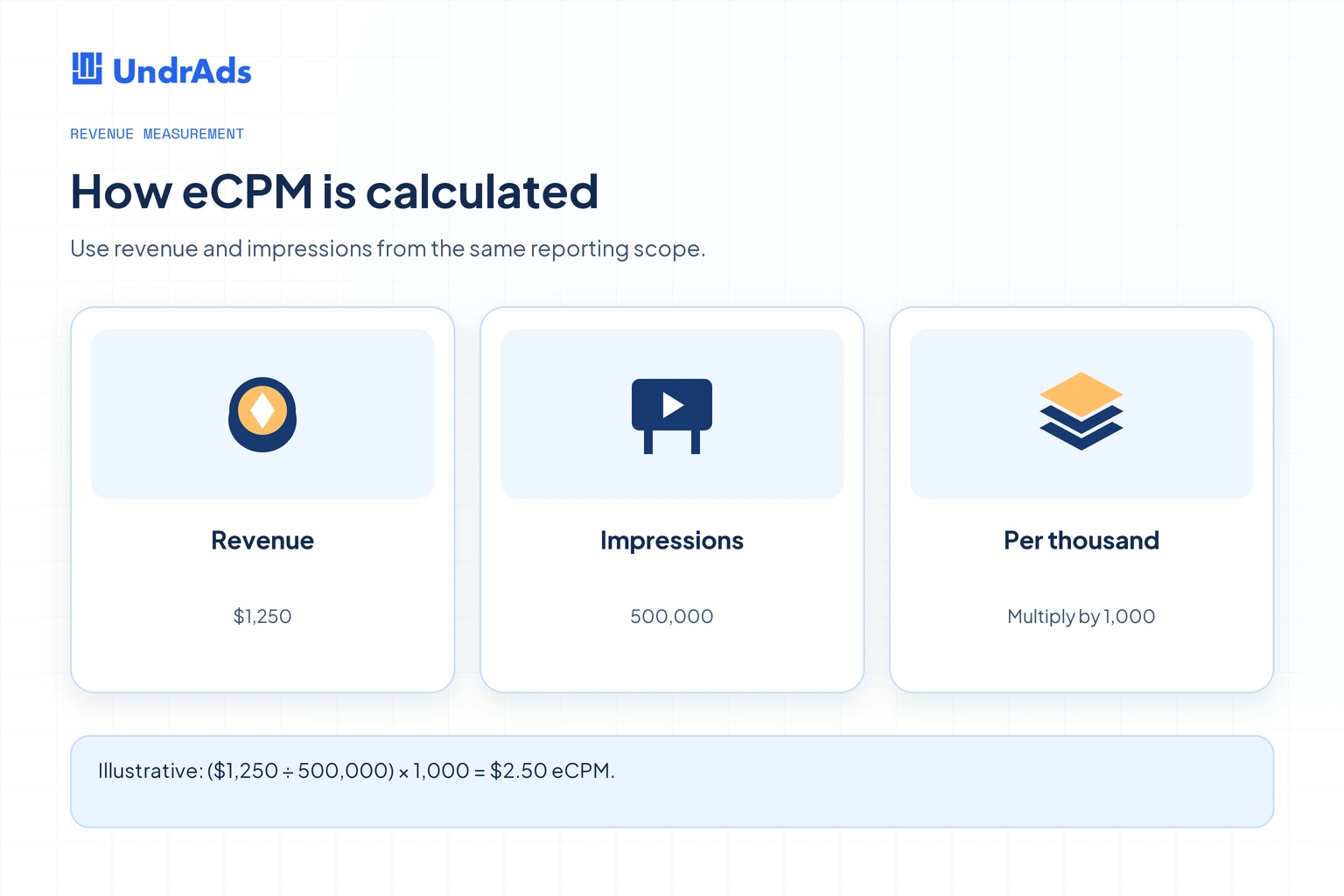
Use eCPM as one rate within the decision. Revenue divided by recorded impressions and multiplied by 1,000 produces the rate for that scope. Keep counts and currency consistent. Revenue per active user, purchases, retention, reliability and cost answer additional questions.
Step 1: Traffic Scale
Traffic affects sample size and the economics of operating work. It does not create a universal permission threshold for bidding. Ask whether the relevant country, platform and format cohorts can produce a useful comparison for the change being proposed.
- Check whether relevant cohorts can support the test
- Avoid treating one global DAU threshold as eligibility
Step 2: Technical Readiness
Technical readiness includes current dependencies, partner mapping, privacy behavior and testing. Assign release and maintenance ownership. If those foundations are unresolved, changing the auction method can add uncertainty without answering the business question.
- Confirm dependency and platform compatibility
- Assign release, QA and ongoing ownership
Step 3: Revenue Trend
A revenue plateau or decline needs diagnosis. Compare traffic mix, requests, actual displays, prices and recent releases. A new auction mechanism is one possible test, not a default cure for every downward graph.
- Diagnose the observed change before selecting a remedy
- Use a comparable baseline and a defined outcome
Step 4: Geographic Reach
Use actual market and format coverage. A multi-country audience can justify more detailed reporting, but it does not prove bidding always improves each region. Compare relevant cohorts and avoid overinterpreting tiny samples.
- Review actual demand coverage by market and format
- Do not infer a regional guarantee from a platform label
Step 5: Operational Capacity
Measure the ongoing work in both configurations. A lean team may value reduced ordering tasks, but still needs integration and incident ownership. Include partner support and the cost of keeping data trustworthy.
- Measure current configuration and support work
- Include the maintenance required after migration
The Decision Table
Use the four questions in the decision table to identify the next concrete action. The table recommends a diagnosis or test rather than assigning mechanisms from an arbitrary traffic cutoff.
| Question | Evidence | Next action |
|---|---|---|
| Is a required partner unsupported? | Current platform and format guide | Find a supported path before rollout |
| Is current delivery broken? | Load, show and lifecycle diagnostics | Repair and establish a baseline |
| Is a new path promising? | Relevant demand and reliable measurement | Run a controlled comparison |
| Does the test justify the cost? | Combined revenue, user and operating result | Retain, revise or stop |
Strategic Recommendation by Growth Stage
Growth stage can organize planning, but it should not dictate the mechanism. A new app may begin with compatible bidding sources, while an established app may retain a useful supported waterfall path. Match the configuration with actual requirements.
Early-stage apps: build a maintainable foundation
A first monetization release needs a maintainable foundation and reliable measurement. Choose compatible demand and a manageable scope. Do not add a waterfall solely because the app is young, or add bidders solely to match another studio’s architecture.
- A coherent first monetization implementation
- Supported demand for the intended audience
- Reliable test and production behavior
- A reporting plan with clear ownership
Growing apps: test a specific configuration gap
As the business expands, identify the specific configuration or demand gap. Use a controlled transition and preserve the original baseline. Additional traffic can improve measurement but also increases the consequences of a broken integration.
- An inventory of working and proposed partners
- A controlled comparison for the change
- Stable event and revenue definitions
- A staged release and recovery plan
Established apps: govern and measure the whole stack
At scale, governance and evidence matter more. Review source contribution, supported dependencies and operating cost across the portfolio. A standardized process can support different configurations where inventory needs differ, without declaring one label mandatory for all apps.
- Maintainable demand and configuration coverage
- Reliable reporting across relevant cohorts
- Measured combined revenue and user outcomes
- Clear responsibility for updates and incidents
Where to Go From Here
Write the decision, assumptions and acceptance criteria in a reviewable record. Keep favorable, neutral and negative findings. Reuse current diagrams and test cases across the portfolio, while validating the settings and dependencies of each actual integration.
Evaluate operating support against the actual gap
UndrAds can be evaluated for monetization operations in a compatible stack. Confirm the permitted changes, integration and responsibilities. Run a measured pilot against the documented operating gap and business objective, rather than a universal revenue promise.