

Offerwall results come down to four configuration choices: which currency the reward pays out in, where the entry point sits, what triggers it, and how deep the tasks are allowed to go. Genre decides the right answer to each one. A match-3 game and a 4X survival game need opposite settings on three of the four.
Most studios treat the offerwall decision as a procurement question. They compare SDKs, check payout rates, sign with one, drop it into the store screen, and watch it produce a rounding error. The SDK was rarely the problem. A wall configured for a game with 90-second sessions will underperform badly in a game with 40-minute sessions, and the reverse is just as true.
This piece maps the configuration to the genre. It assumes you already know what an offerwall is and are past the question of whether to run one.
The four decisions that define an offerwall setup
Before genre, understand what you are actually configuring. Every offerwall integration comes down to these:

| Decision | What it controls | Most common failure |
|---|---|---|
| Reward currency | Whether the wall feels worth the effort | Paying soft currency, which players already earn free from rewarded video |
| Entry point | Who ever sees the wall | A tiny icon buried in settings, or a single store placement |
| Trigger | Whether the wall shows up at a moment of need | Passive placement only, with no shortfall or fail-state trigger |
| Task depth | Payout ceiling and completion rate | Allowing 7-day retention offers in a game with 3-minute sessions |
The currency decision is the one studios get wrong most often. MY.GAMES’ offerwall guide states the rule cleanly: offerwalls should pay hard currency, rewarded video should pay soft currency. An offerwall asks for real effort, sometimes days of it. If it pays the same currency a player gets for watching a 30-second video, nobody completes an offer, and if both formats pay hard currency, the economy floods.
The entry point decision has the biggest measurable swing. ironSource data cited by Mistplay found that adding a home screen placement lifts overall offerwall open rates by 38%. Placement inside the currency tab of the store performs well because those players are already in a purchase-intent state, and icon size matters enough that smaller icons measurably underperform.
Why genre changes the answer
Offerwalls work by inserting a fourth option into a moment where a player has three: spend money, grind longer, or quit. That moment only exists in games with progression gates and resource scarcity. The deeper and more frequent those gates, the more room an offerwall has to operate.
Genre also sets how much economic headroom you have. H1 2026 data from AppMagic, reported by PocketGamer.biz, shows strategy holding the top spot at $9.1bn in gross player spending, puzzle overtaking RPGs at $7.6bn on 20% year-over-year growth, and RPGs down 14% to $7bn. A genre that is losing revenue has less tolerance for a monetization channel that might cannibalize its core. A genre that is growing can afford to experiment.
Session length is the third factor. It caps the task depth players will accept. Someone playing 40-minute strategy sessions will complete a multi-day offer. Someone playing three 90-second puzzle sessions will not.
Genre-by-genre configuration
| Genre | Typical ads/IAP split | Reward currency | Primary entry point | Task depth to allow | Expected engagement | Main risk |
|---|---|---|---|---|---|---|
| 4X / survival strategy | 20-40% ads | Hard currency, timer skips | Resource shortfall popup at build gates | Deep, multi-day offers | Medium-high | Whale cannibalization |
| RPG / gacha | 10-30% ads | Upgrade materials, energy, event tokens | Energy exhaustion screen | Medium to deep | Medium-high | Premium pull currency dilution |
| Puzzle / match-3 / merge | 40-60% ads | Coins sized to a booster bundle | Level fail and out-of-lives popup | Shallow to medium | Medium | Competing with the rewarded-video continue |
| Simulation / idle / tycoon | 30-50% ads | Hard currency, timer skips | Home screen driver plus store | Full range | Highest | Lowest risk of any genre |
| Casual / hybrid casual | 40-60% ads | Single hard currency | Rewards hub, home screen | Shallow | Medium-low | Economy too thin to absorb large rewards |
| Social casino | Low | Chips | Out-of-chips screen | Shallow | Low | Platform reward policy |
| Hypercasual | 85-95% ads | Not applicable | Not applicable | Not applicable | Very low | No economy to reward into |
Genre splits above follow the ranges published in 2026 F2P monetization model comparisons. The detail behind each row follows.
4X and survival strategy

Strategy is the highest-earning genre on mobile and it has the structural feature offerwalls need most: resource scarcity that never resolves. Build timers, research gates, troop costs, and alliance events all create moments where a player wants a resource right now.
Configure for depth. These players are already inside a multi-day loop, so they will accept multi-day offers, which are the highest-paying inventory on any wall. Put the entry point on the shortfall popup that appears when an upgrade is blocked, and add a persistent driver in the currency tab.
The thing to guard is your top spender segment. A player who spends $200 a month has no reason to complete a 45-minute offer for $3 of gems, and showing them the wall dilutes a screen you would rather use for a pack offer. Segment spenders out of the offerwall audience entirely and target the non-paying and low-paying majority, which is where ad monetization adds the most incremental revenue anyway.
RPG and gacha

RPGs have the deepest progression systems and the most fragile economies. Premium pull currency is the entire business model, so paying it out through an offerwall is the single fastest way to damage revenue. With the genre down 14% year over year, the margin for that mistake is small.
Reward around the pull instead of into it. Stamina and energy refills, character upgrade materials, and event-specific tokens all create real value for the player while leaving the gacha economy untouched. This also gives you a natural trigger: the energy exhaustion screen is the highest-intent moment in an RPG session, and it fires several times a day.
Task depth can run medium to deep. RPG players are patient by selection.
Puzzle, match-3, and merge

Puzzle is the growth story of 2026, up 20% year over year and now the second largest genre by revenue. It is also the genre where the offerwall has the clearest natural home: the level fail screen.
The complication is that the fail screen is already occupied. Most match-3 games run a rewarded video continue there, and it converts well. Putting an offerwall in the same slot creates a choice that slows the retry loop, which is the loop that drives session count. Better placement is the out-of-lives screen, one step further along, where the player has already decided to stop or to spend.
Keep tasks shallow. Low-barrier tasks reach completion rates approaching 100%, and completion falls sharply as difficulty rises. Surveys and single-install offers fit a puzzle player’s session budget. A 7-day retention offer does not.
Size the coin reward to a booster bundle, not to a life refill. Lives are what the rewarded video pays for.
Simulation, idle, and tycoon
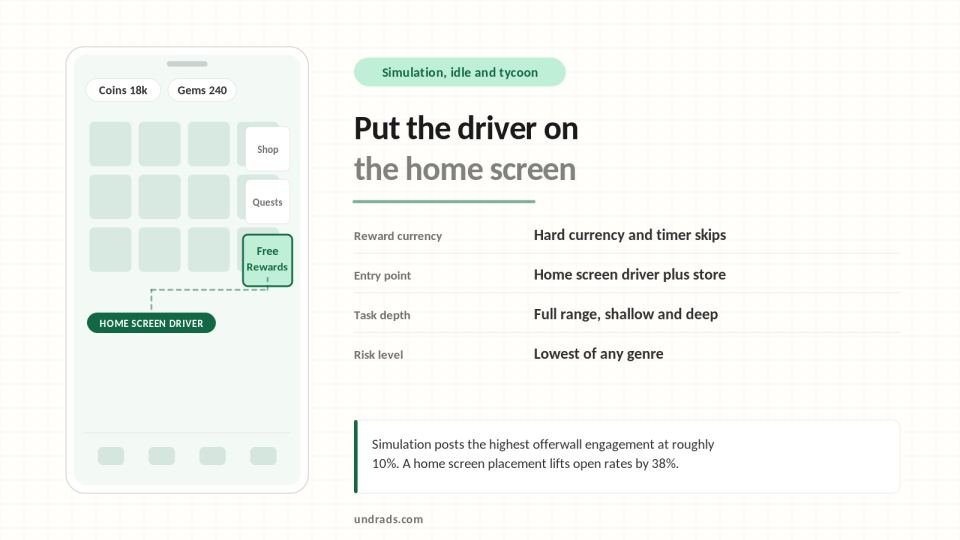
If you are running your first offerwall test and you have a simulation title, start there. Simulation games post the highest offerwall engagement rates of any genre at around 10%, roughly triple what social casino sees.
The reason is behavioral. Sim players browse. They open menus, compare upgrades, and plan expansions, which makes them far more likely to explore a home screen driver out of curiosity than a player in a fast-twitch genre. Timer skips also give you a reward with real perceived value that costs your economy very little.
This genre tolerates the full range of task depth. Run shallow and deep offers side by side and let completion data sort it out.
Casual and hybrid casual

Hybrid casual was the standout monetization gainer of the last two years, with blended ARPDAU running roughly $0.15 to $0.50 against $0.03 to $0.08 for hypercasual, according to 2026 hybrid casual design analysis. That gap exists because hybrid casual games added a meta layer with an actual economy, which is exactly the precondition an offerwall needs.
The constraint here is scale, not fit. A hybrid casual economy usually has one hard currency and a shallow price ladder. If your most expensive item costs 300 gems and an offer pays out enough for 900, the reward breaks the game. Cap daily offerwall currency at what a committed player could grind in two or three sessions, and stick to shallow tasks so payouts stay proportionate.
Put the entry point in the rewards hub. Players who already visit a daily rewards screen have the habit of collecting free items, which is the closest behavioral match to offerwall completion.
Social casino

Social casino runs around 3% offerwall engagement, the lowest of the major genres. It is still worth running because chips map cleanly to a reward and the out-of-chips screen is a strong trigger, but treat it as a small line item rather than a channel that moves your blended number.
Policy is the real consideration. Google’s rewarded ad policies prohibit direct monetary rewards outright, require that rewards be redeemable only inside your own app and be non-transferable, and cap discount or voucher rewards at 25% of the item’s value. Casino-adjacent reward mechanics get scrutinized more closely than most, so get the reward structure reviewed before you build it.
Hypercasual

Skip it. Hypercasual monetizes at 85-95% ads with sessions measured in minutes and an economy that usually amounts to a coin counter. There is no progression gate to unblock and no reward worth a player’s time on an offer.
The exception is a hypercasual title being reworked into hybrid casual. Once a meta layer with real currency exists, revisit the decision. Until then your revenue is coming from interstitial and rewarded video density, which is a different optimization problem covered in best ad formats for mobile gaming apps.
Sizing the reward against your economy
This is where most offerwall integrations quietly fail, and it is a math problem rather than a judgment call.
Published guidance puts offerwall rewards at roughly 15-25% of a player’s total currency earnings in a session. Below that range the wall feels pointless. Above it, players optimize for offers instead of playing, and IAP conversion drops.
Work backward from your median pack. If your entry-level purchase is $4.99 for 500 gems, that sets your reference price at roughly 100 gems per dollar. An offer that nets you $3 should reward somewhere near 150 to 200 gems after accounting for the wall’s cut, which lands close to a third of your entry pack. That is generous enough to motivate and small enough that a player who wants the 500-gem bundle still buys it.
Then apply a daily cap. Without one, a small segment of players will complete every available offer on day one, collect several thousand gems, and exit your monetization funnel permanently. Cap at two to three sessions’ worth of normal earnings.
Running the test
Offerwall performance is not readable from offerwall revenue alone. The number that decides whether to keep it is blended ARPDAU across the whole cohort, because that is the only figure that nets out cannibalization.
Run it this way:
- Expose 10% of your player base, hold out the rest, and run for a minimum of 30 days so D30 retention data accumulates.
- Segment out your top spender decile from the exposed group.
- Track four numbers against the holdout: offerwall ARPDAU, IAP ARPPU, D7 and D30 retention, and average session length.
- Read IAP ARPPU first. If it dropped in the exposed cohort, your reward is oversized, regardless of how good offerwall revenue looks.
- Only then compare blended ARPDAU. New revenue minus cannibalized revenue is the actual result.
Retention is usually the pleasant surprise. Industry data on offerwall cohorts consistently shows retention lift rather than the churn studios fear, because the wall gives a stuck player an alternative to quitting. Treat it as a secondary metric, not the justification.
If you cannot run a clean holdout, at minimum stagger the rollout by geography and compare tiers. Testing multiple configurations in parallel before committing is the same principle behind the “AND” approach to monetization.
What to do after the first 30 days
An offerwall is not a set-and-forget placement. Offer inventory rotates, completion rates decay as your player base exhausts the good offers, and payout rates shift by geo every month. Studios that treat the wall as a one-time integration see revenue fall steadily from month two.
The ongoing work is offer curation, reward recalibration when your economy changes, and entry point testing. That is real ad ops load on top of everything else your team already manages, which is why ad operations becomes a bottleneck for gaming studios past 100k DAU and increasingly why studios move that layer to automated offerwall and rewarded management.
FAQ
Should the offerwall reward hard currency or soft currency?
Hard currency, in almost every case. Offerwalls demand more effort than any other rewarded format, sometimes days of it, so the reward has to be worth more than what a rewarded video pays. Keep soft currency assigned to rewarded video so the two formats do not compete for the same player motivation. The exception is gacha RPGs, where you should pay in upgrade materials or energy rather than the premium pull currency.
How many entry points should one game have?
Two or three. One passive driver for discovery, usually the home screen or the store currency tab, plus one or two triggered placements at moments of resource shortfall. Beyond three the wall starts reading as spam, and open rate per placement falls faster than total opens rise.
Will an offerwall cannibalize my IAP revenue?
Only if the reward is oversized. Cannibalization happens when a player can obtain through an offer what they would otherwise have bought. Keeping rewards near 15-25% of session currency earnings, applying a daily cap, and excluding your top spender segment removes most of the risk. Measure it directly by comparing IAP ARPPU between an exposed cohort and a holdout.
What offerwall engagement rate should I expect?
It varies widely by genre. Simulation games lead at around 10%, social casino sits near 3%, and most other genres land between. Of the players who open the wall, 15-30% typically complete at least one offer in a well-configured integration.
Can I run an offerwall in a game aimed at kids?
No. Apple’s App Store Review Guidelines prohibit offerwalls in apps whose primary audience is children, and both stores require explicit disclosure that a reward is attached to the offer. If your title falls under a kids or family category on either store, the offerwall is off the table and rewarded video with strict content filtering is the alternative.
Is it worth running two offerwall providers at the same placement?
For high-DAU titles, often yes. Layering providers increases the pool of available offers, which matters because completion rates decay as players exhaust good inventory. It also adds integration weight and a second relationship to manage, so it makes sense once your single-provider offerwall revenue is large enough that a percentage lift covers the operational cost. Below that, get one wall configured properly first.
Get your offerwall configuration audited
If your offerwall is live and producing less than it should, the cause is usually one of the four settings in this article rather than the provider you picked. UndrAds runs offerwall configuration audits for gaming studios, covering reward sizing against your economy, entry point placement, task depth, and segment exclusions, with the cannibalization math done against your actual IAP data.


