

These four names get compared as if a publisher has to pick one and live with it. That framing is wrong in two directions. Three of them do separate jobs inside the same stack, and two of them are the same product at different tiers.
Google removed unified pricing rules from Ad Manager in December 2025, which changed how floors work for every publisher running Google demand alongside anything else. The remedies decision in the DOJ ad tech case is still pending, and most observers expect it around mid-2026, followed by appeals. Publishers making stack decisions right now are making them on shifting ground.
Here is what each product actually is, who qualifies for it, what it costs, and how the four fit together.
The short version
| Product | What it is | What it controls | Who can use it | Cost to publisher |
|---|---|---|---|---|
| AdSense | Ad network | Google’s own advertiser demand, served through a simple tag | Any approved site or publisher | 68% publisher share on Google Ads demand, 80% after third-party buy-side fees |
| Google AdX | Ad exchange | Real-time auction access to premium programmatic demand | High-volume publishers directly, everyone else through an MCM partner | Google’s fee sits inside the auction. MCM partners typically take 10% to 20% |
| Google Ad Manager | Ad server | Which ad wins and serves in a given slot, across all demand sources | Anyone with an AdSense account | Free under monthly impression caps |
| Ad Manager 360 | Enterprise tier of the same ad server | Same job, plus first-party audience segments, advanced video, MCM | Publishers past the impression caps, or via a certified partner | Negotiated per network |
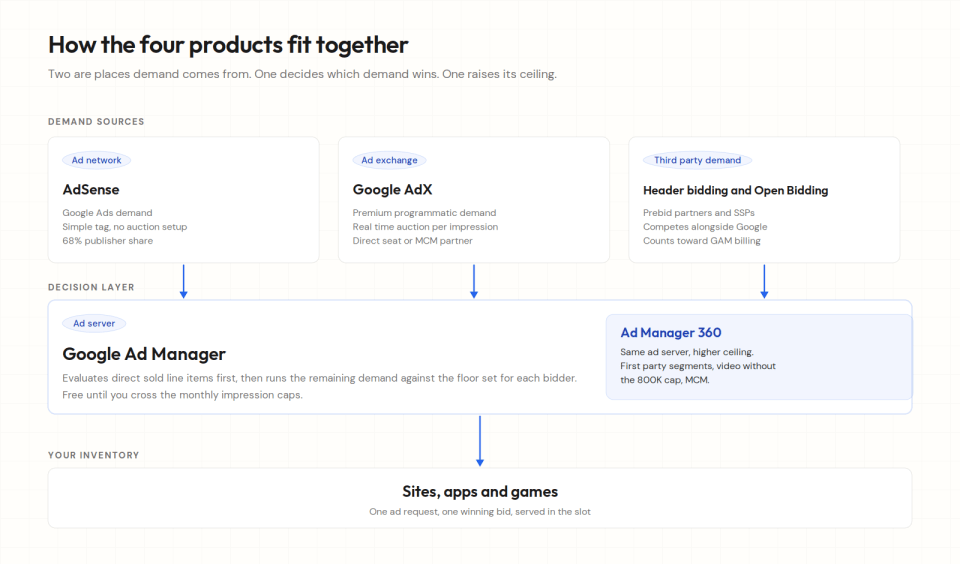
The mental model that keeps this straight: AdSense and AdX are places demand comes from. Ad Manager is the thing that decides which demand wins. Ad Manager 360 is Ad Manager with the ceiling raised.
AdSense: the entry point, and the one with a published rate card
AdSense is a network. You paste a tag, Google fills the slot with demand from Google Ads, and you get paid. There is no auction for you to configure, no line items, no direct sales workflow.
The revenue split is the clearest number in the entire Google stack. Publishers keep about 68% of revenue when advertisers buy through Google Ads, and 80% after the third-party platform takes its fee when demand comes from outside Google. That 68% figure has held since 2003. The November 2023 restructure split the share into separate buy-side and sell-side rates and moved payment from per-click to per-impression, without changing what most publishers take home.
What AdSense gives up is control. You cannot run direct-sold campaigns through it, cannot set granular floors per demand source, and cannot bring in competing exchanges. For a site under a few hundred thousand monthly pageviews, that tradeoff is usually correct. The operational overhead of a full ad server is not worth it at that scale. Our breakdown of how AdSense works and where its limits sit goes deeper on the setup itself.
AdX: the demand upgrade most publishers cannot access directly
Google Ad Exchange is where the real programmatic money moves. Instead of Google Ads demand arriving through a fixed network relationship, AdX runs a real-time auction where large buyers compete impression by impression. CPMs are usually meaningfully higher than AdSense on the same inventory, which is why AdX access is the single most requested upgrade in publisher monetization.
The catch is eligibility. Google does not publish the criteria, but industry partners consistently report a threshold in the range of 10 to 20 million monthly pageviews for a direct AdX seat. That puts a direct account out of reach for the overwhelming majority of publishers, including plenty of profitable ones.
The route around it is MCM. Multiple Customer Management is Google’s program that lets certified partners manage Ad Manager and AdX inventory on behalf of other publishers, with the partner acting as parent publisher and the site owner as child publisher. It replaced the older SPM program. Partners typically take 10% to 20% of AdX revenue in exchange for access plus whatever optimization work they do on top.

UndrAds is an authorized Google partner and provides AdX access through MCM. The difference from a standard reseller is what happens after onboarding. A typical MCM arrangement hands you the account and leaves the configuration alone. UndrAds runs the account with an autonomous agent that scores AdX and every competing exchange against live auction data and resets floors and demand priority per query rather than per quarterly review.

That distinction became more valuable in December 2025. With unified pricing rules gone, publishers can now set different floors for different bidders in the same auction, for example requiring one bidder to clear $5 while others compete at $2. That is a real yield lever, and it is also a configuration surface that ages badly if nobody touches it. Our guide to AI floor price optimization covers why static floors quietly cost money.
Google Ad Manager: the ad server everything else plugs into
Ad Manager is the decision layer. Every ad request hits GAM, and GAM decides what fills it: a direct-sold campaign, an AdX bid, an AdSense backfill, an Open Bidding partner, or a header bidding line item from Prebid.

It is free until you cross the impression caps, which vary by where your audience is:
| Region | Free monthly non-video impressions |
|---|---|
| US, Canada, Australia, New Zealand | 90 million |
| Much of Europe, Asia, LATAM, MENA (including India, Vietnam, Turkey, Mexico, Brazil-adjacent markets) | 200 million |
| Everywhere else | 150 million |
| Video, all regions | 800,000 |
Those limits come from section 2 of the current Ad Manager terms, and the video ceiling is the one that catches publishers off guard. A modest video program will cross 800,000 impressions long before a display program approaches 90 million.
Past the cap, Google bills for impressions served by non-Google demand: direct sales, third-party networks, and header bidding partners. Google’s own demand does not count against the cap.
What GAM unlocks that AdSense does not: direct-sold inventory, granular targeting and forecasting, competitive header bidding setups, and per-bidder pricing rules. It also introduces real operational weight. Somebody has to maintain the tags, the yield groups, and the pricing rules. If you are weighing whether that weight is worth it, our comparison of Google Ad Manager alternatives covers what changes when you leave, and our primer on Ad Manager itself covers the mechanics.
Ad Manager 360: the same product with the ceiling removed
Ad Manager 360 is not a different platform. It is the paid enterprise tier of the same ad server, and the qualification bar is the same impression threshold that triggers billing on the free tier: 90 million monthly non-video impressions in the US, Canada, Australia and New Zealand, 200 million in the listed European and Asian markets, 150 million elsewhere.
What you get for it:
- First-party audience segments built from your own inventory, which you can package and sell to advertisers directly
- Advanced video and CTV serving without the 800,000 impression ceiling
- Multiple Customer Management, which is the feature that lets certified partners represent other publishers’ inventory
- Programmatic Guaranteed and richer deal types
- Dedicated account support and higher API and reporting limits
Pricing is negotiated per network rather than listed, usually against impression volume, and is quoted either by a Google sales rep or through a reseller.
The practical note for mid-size publishers: 360 access is available below the threshold through a Google Certified Publishing Partner or an MCM partner. You get the feature set without hitting the volume bar yourself, in exchange for a revenue share.
How the four actually stack

For a single ad request on a mature web setup, the sequence looks like this:
- The page loads and header bidding wrappers run their auction in the browser, collecting bids from Prebid partners.
- The winning header bid is passed into Google Ad Manager as a key-value.
- GAM evaluates direct-sold line items first, since those carry delivery commitments.
- Remaining demand competes: the header bid, AdX, Open Bidding partners, and AdSense backfill, each against whatever floor applies to it under the current pricing rules.
- The highest clearing bid serves.
AdSense and AdX rarely coexist meaningfully on the same inventory once a publisher has AdX, because AdX demand overlaps AdSense demand at better rates. AdSense usually stays as backfill or gets removed entirely.
On the app side the shape is different. Mediation platforms sit where the ad server sits on web, and AdMob is the common entry point rather than AdSense. Our comparison of in-app bidding and waterfall setups and the AdMob primer map that side of the stack.
Which combination fits you

Web publishers under roughly 500K monthly pageviews. AdSense alone. The revenue at that scale does not cover the operational cost of running an ad server, and eCPM gains from a more complex setup get eaten by the time spent maintaining it.
Web publishers between 500K and 10M monthly pageviews. Ad Manager plus AdX through an MCM partner, with header bidding layered on. This is where the largest available lift sits, and where most publishers stall because the setup work is real. Our web publisher solutions page covers what that transition involves.
Publishers past the impression caps. Ad Manager 360 direct, with first-party segments and direct sales as the differentiator. At this scale the question stops being which Google product and starts being how much of your inventory should route through Google at all.
App developers and game studios. AdMob or a mediation platform first, then GAM for app inventory once you have scale and want per-query control. Studios running multiple titles under one publisher entity tend to hit the ceiling of what mediation alone can deliver, and app developers with steady session volume see the same pattern.
Benchmarks for judging whether your current setup is underperforming are in our eCPM guide.
What the antitrust case could change, and what to do about it now
In April 2025, Judge Leonie Brinkema ruled that Google illegally monopolized the publisher ad server and ad exchange markets, and that it unlawfully tied DFP and AdX together. The DOJ is pushing for divestiture of AdX and, if needed, the rest of the ad server. Google has proposed behavioral remedies instead, including interoperability with rival ad servers and Prebid. Closing arguments finished in November 2025, and Brinkema has signaled skepticism about the practicality of a forced sale, particularly around timing and whether a buyer exists.
Separately, the European Commission fined Google €2.95 billion over ad tech self-preferencing, with structural separation warnings attached. The unified pricing rollback in December 2025 was a direct response to that pressure.
The useful takeaway is narrow. Do not restructure your stack in anticipation of a ruling that may take another year and will be appealed regardless. Do take the changes that have already landed. Bidder-specific floors are live now, and most publishers have not touched their pricing rules since the change.
The gap none of these four products closes
Every product above is a configuration surface. AdX sets the demand you can access, GAM sets the logic that picks winners, pricing rules set the floors. All of them assume somebody is watching and adjusting.
That assumption is where revenue quietly leaks. A tag decays, a bidder starts timing out, a floor that was right last month starts suppressing fill. Ad ops teams review performance every few hours and switch tags after they have spotted the drop. The window between the drop and the reaction, commonly four to six hours, is unrecoverable regardless of which Google tier you are on. A property earning $200 an hour loses more than $700 per incident, several times a week.
Upgrading from AdSense to AdX raises your ceiling. It does nothing about reaction time. UndrAds connects to your existing Ad Manager setup through API access, with no SDK and no app changes, monitors metrics continuously, and switches within the hour instead of the following afternoon. If you are comparing options in this category, our roundup of AI ad monetization platforms and the ad tag automation page cover the mechanics.
FAQ
Can I run AdSense and AdX at the same time?
Yes, and many publishers do during a transition. AdSense typically serves as backfill under AdX in Ad Manager. Once AdX is performing, most publishers find AdSense wins few impressions and remove it to reduce tag weight.
Do I need Google Ad Manager to use AdX?
Yes. AdX is accessed through Ad Manager, which is part of why the DOJ argued the two were unlawfully tied. Google’s proposed behavioral remedies include letting publishers contract separately for AdX and the ad server, though nothing has been ordered yet.
How much traffic do I need for a direct AdX account?
Google does not publish the threshold. Partners who handle these applications consistently report 10 to 20 million monthly pageviews as the practical bar for a direct seat. Below that, an MCM partner is the realistic path. UndrAds is an authorized Google partner and can tell you where your inventory stands.
Is Ad Manager 360 worth paying for?
If you are past the free impression caps you are already paying for overages, so 360 becomes a pricing conversation rather than a yes or no. Below the caps, the features that justify it are first-party audience segments and video without the 800,000 impression ceiling. If you are not selling audience segments directly or running significant video, the free tier covers it.
What changed with unified pricing rules?
Until December 2025, Google required a single floor across all demand sources in Ad Manager. That is over. Publishers can now set bidder-specific floors, so Google demand and independent SSPs can face different minimums in the same auction. Most publishers have not revisited their pricing rules since.
Where does AdMob fit?
AdMob is the app equivalent of AdSense: Google’s network for mobile app inventory, accessed by SDK. App publishers who outgrow it move to mediation or to Ad Manager for apps, which is the same ad server described above with app-specific inventory handling.
Find out what your current setup is leaving behind
Before changing tiers or platforms, get a number on what the existing one is losing. UndrAds runs a revenue leak audit on your live Google Ad Manager account: how often performance drops, how long each drop runs before anyone reacts, and what that window costs across a month. If AdX access is the gap, UndrAds is an authorized Google partner and can route that too.


